BTU/hr to Kilowatts Converter
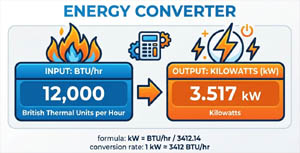
If you’ve ever shopped for an air conditioner, a furnace, or a high-end space heater, you’ve likely encountered two different languages for measuring power: BTUs and Kilowatts.
One sounds like a measurement from an old steam engine, while the other sounds like your monthly electric bill. Our BTU/hr to Kilowatts Converter acts as your personal translator, helping you compare heating and cooling systems with professional accuracy.
| BTU/hr | Kilowatts (kW) |
|---|---|
| 1,000 BTU/hr | 0.2931 kW |
| 5,000 BTU/hr | 1.4655 kW |
| 10,000 BTU/hr | 2.931 kW |
| 20,000 BTU/hr | 5.862 kW |
| 50,000 BTU/hr | 14.655 kW |
If you’ve ever shopped for an air conditioner, a furnace, or a high-end space heater, you’ve likely encountered two different languages for measuring power: BTUs and Kilowatts.
One sounds like a measurement from an old steam engine, while the other sounds like your monthly electric bill. Our BTU/hr to Kilowatts Converter acts as your personal translator, helping you compare heating and cooling systems with professional accuracy.
What are these units, anyway?
To understand why you need to convert them, it helps to know what they represent:
-
BTU/hr (British Thermal Unit per Hour): This measures the amount of heat energy required to raise the temperature of one pound of water by one degree Fahrenheit. In the HVAC world, it tells you how much "heat-moving" power a machine has.
-
Kilowatt (kW): This is the standard metric unit of power. Since electricity is sold by the kilowatt-hour, knowing the kW rating of your appliance helps you estimate how much it will cost to run.
How to Use the Converter
We designed this tool to be reversible and lightning-fast. Whether you are moving from Imperial to Metric or vice-versa, here is the flow:
-
Select Your Direction: Use the "From" and "To" dropdowns. You can convert BTU/hr to kW or kW to BTU/hr.
-
Enter Your Value: Type in the rating found on your appliance’s sticker or manual.
-
The "Swap" Feature: If you realize you put the numbers in the wrong boxes, don't delete them! Just hit the Swap button to flip the units instantly.
-
Reset: Planning a whole-home upgrade? Use the Reset button to clear the slate for your next calculation.
The Precision Engineering Behind the Tool
While many people use "rough estimates" (like dividing by 3412), our converter uses precise physical constants to ensure your results are reliable for engineering and budgeting:
-
The Conversion Factor: The code utilizes the exact factor where 1 BTU/hr ≈ 0.00029307 kW.
-
Bidirectional Logic: The script doesn't just do one-way math. It uses a keyed object (
cl_conversionFactors) to pull the correct multiplier based on your selection, ensuring that rounding errors don't pile up. -
Human-Readable Results: We’ve programmed the output to round to four decimal places. This provides enough detail for technical specs without overwhelming the average homeowner with a string of 15 numbers.
Why This Matters for Your Wallet
Knowing the conversion is crucial for Energy Efficiency. Many modern AC units are rated in BTUs for their cooling capacity but in Kilowatts for their energy consumption. By converting them to the same unit, you can calculate the Energy Efficiency Ratio (EER).
The higher the BTU output per Kilowatt of input, the lower your electricity bill will be!
2026-05-09 23:19:10
Taylor Bennett